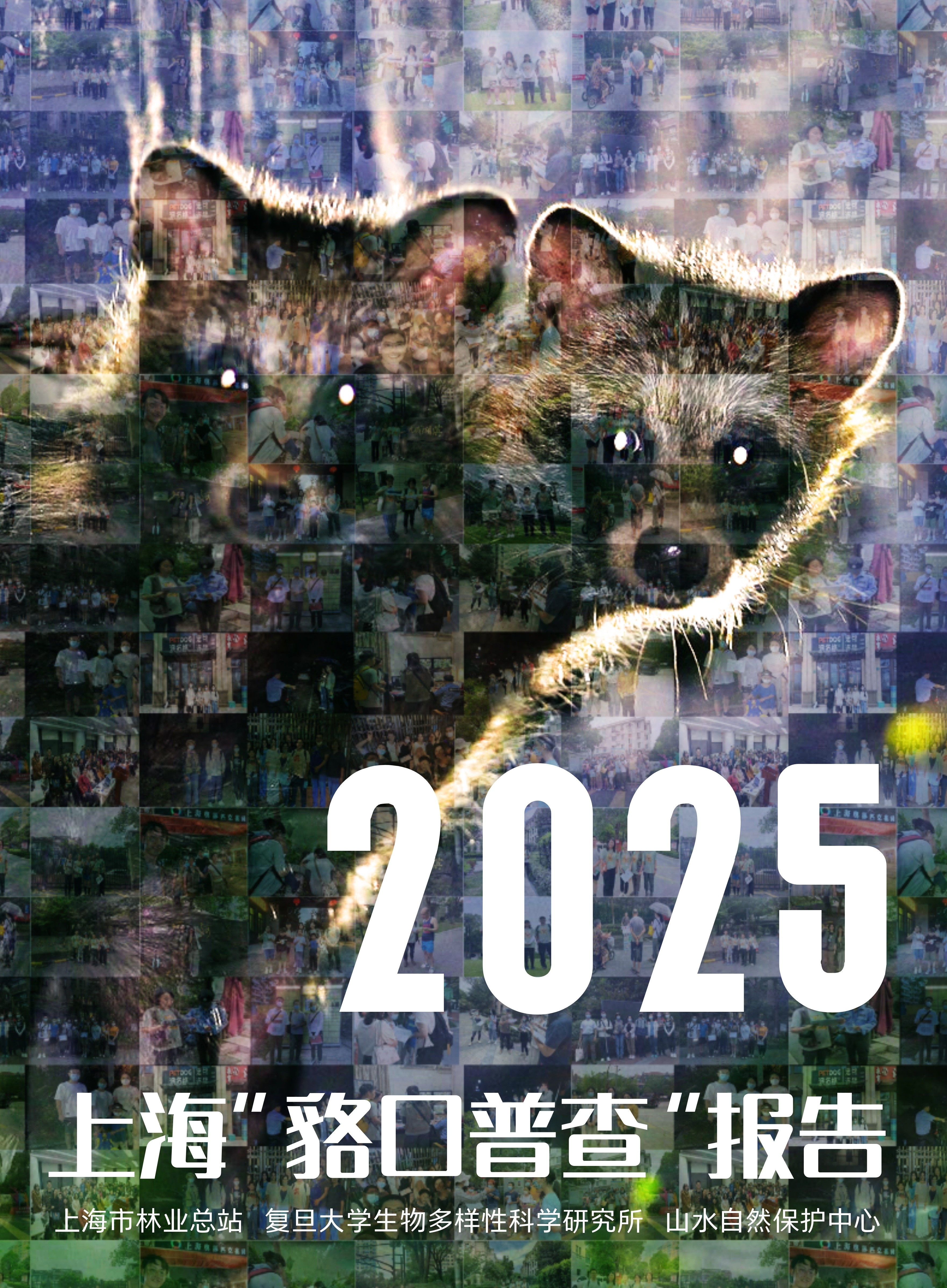
2025 annual Raccoon Dog Census release event was held in the Yangpu District Library in Shanghai
On 30 Nov. 2025, the annual Raccoon Dog Census release event was held in the Yangpu District Library in Shanghai, where we gathered with more than a hundred citizen scientists to share this year’s results.
zz
At the event, Zhou Jingqi from Shan Shui presented, for the first time, the four-year trend of the “Shanghai Residents’ Attitudes Toward Raccoon Dogs” survey. The data show that community residents’ emotional-attitude score toward raccoon dogs increased from 2.46 in 2022 to 3.06, and nearly 80% of residents considered raccoon dogs in their neighborhoods “tolerable.” Correct recognition of the species’ conservation status rose from 51.9% in 2022 to 60.2%.

Volunteer representative Zhou Yun shared how she followed in the footsteps of her nature-loving daughter—transforming from being a “mom chauffeur” into a Raccoon Dog Census team leader who now helps educate residents about wildlife conservation. Professor Wang Fang from Fudan University opened with the question “Why do we count raccoon dogs?” and presented the core scientific findings from the 2025 census, explaining the relationship between people and raccoon dogs as one in which “peace is the norm, though conflicts still occur.” Zheng Yunxiang from the Shanghai Forestry Station introduced community-level protection and management efforts, using Yushanghai Community—home to the city’s first “Raccoon Dog Education Center”—as an example, and provided “centimeter-level” management advice on issues residents care about, such as balcony protection.
 |
 |
 |
The 2025 Raccoon Dog Census collected data from 112 residential communities across nine administrative districts. A total of 519 team leaders and volunteers surveyed raccoon dog distribution and abundance, conducted resident interviews, and documented community environments and management practices. Altogether, 262 valid transect tracks were collected, covering more than 560 kilometers.
Among the 112 communities, 102 recorded raccoon dog presence in 2025—91% of all sites. Notably, Putuo District recorded raccoon dogs for the first time, indicating that the species continues to expand and shift its distribution in Shanghai’s urban environment, highlighting the importance of long-term monitoring. In the 102 communities with raccoon dogs, the average density was 0.41 individuals per hectare, and the average encounter rate was 1.02 individuals per kilometer of transect, similar to 2024 levels but clearly lower than in 2022. This suggests that raccoon dog populations remain generally stable and are approaching humans less proactively, helping to reduce potential human–wildlife conflict risks. In habitat selection, urban raccoon dogs showed a strong preference for high greenery and low disturbance. Improper feeding and poor wet-waste management were the main factors driving abnormal increases in raccoon dog numbers.

If you are interested in the 2025 Raccoon Dog Census Report, you are welcome to click to download the PDF version( in Chinese)